Unibest
01Tradition:NLP logical levels · Positive psychology · Cognitive-behavioural tradition·10 viewpoints

Inner Growth

Only those who look inward can see the way outward clearly.

Most problems in the outer world have roots in the inner one: unclear goals, conflicting beliefs, emotional friction, runaway desire. This discipline collects workable tools for inner management — from six-level planning and the scale of consciousness to the causes-and-conditions of emotion and the arithmetic of happiness: separate what can be controlled from what cannot, then invest attention where it compounds.

Public viewpoints10 viewpoints

Six Logical Levels: The Upper Three Determine the Lower Three

Before working on capability and action, align mission, identity and beliefs — the upper three levels determine the lower three.

The six logical levels split a person's situation into: mission (relation to the world), identity (who I am), beliefs and values (what I hold true), capability, behaviour, and environment. The upper three run on the subconscious and answer "willing or not"; the lower three answer "able or not" and "supported or not". The upper three determine the lower three — will outweighs skill, so align it first. Most people grind only on capability and behaviour, which is treating symptoms.

The academy's seven disciplines are laid out along exactly these six levels: Inner Growth sits at mission, Cognition & Talent at identity, Classical Chinese Statecraft at beliefs and values, Decision Science at capability, Organisation & Governance at behaviour, and AI & Infrastructure at environment and resources. Pharma Trade in Practice belongs to no single level — it is the proving ground where all six are tested against real business. The upper levels set direction; the lower ones make it real. Both directions must be walked: top-down for direction, bottom-up for verification.

The model is isomorphic to 5W2H and to the Golden Circle: ask why first, then how, then what. Operationally: set goals the SMART way, iterate on a PDCA loop, and when results fall short, look inward first. When direction and energy align, capability and external support begin to resonate.
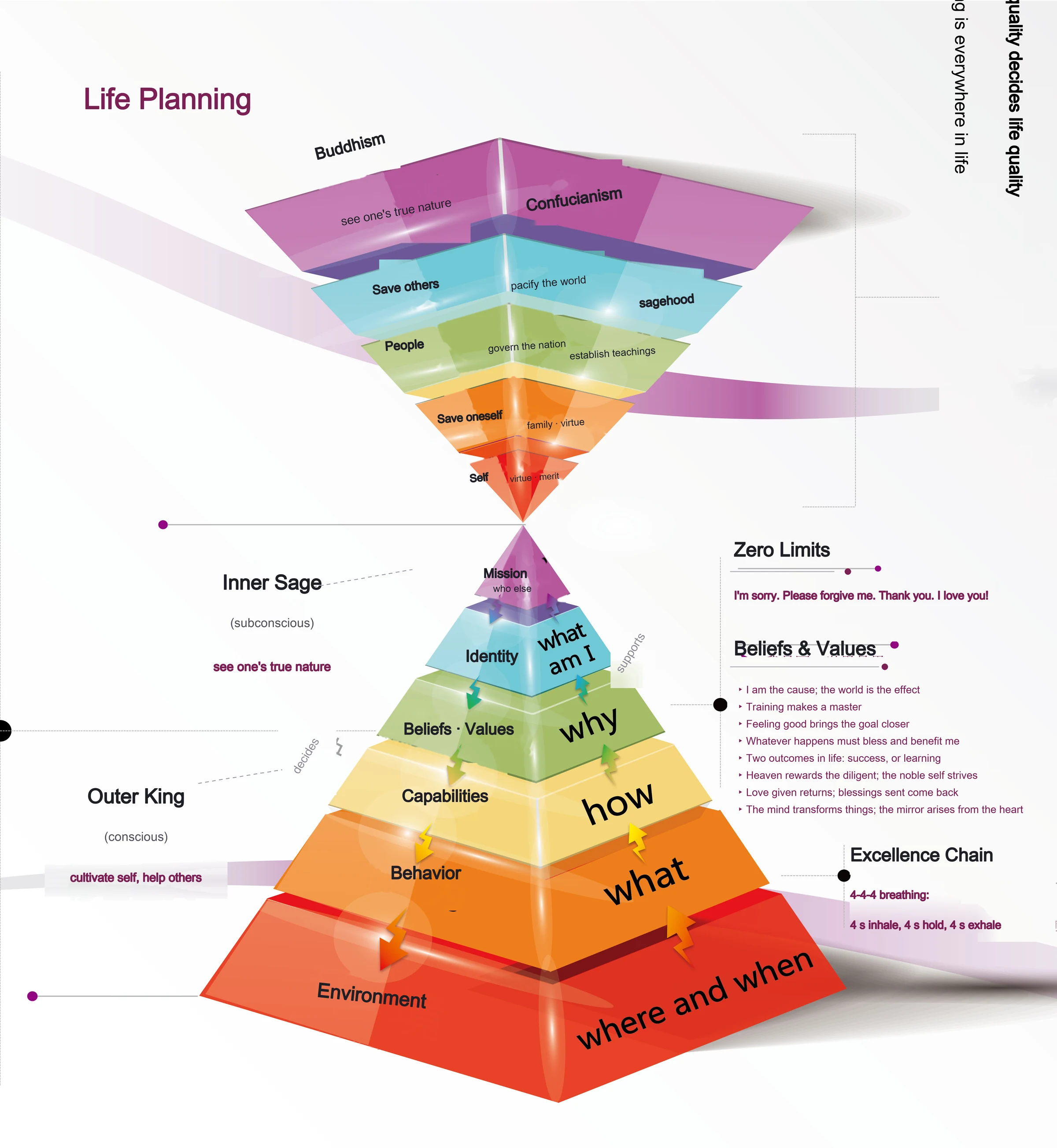
Life Planning — hourglass and pyramid (course diagram)

Ten Questions: Working Backwards From the End

Ten questions running from "what value can I create" to "is this truly what I want" — a single pass through mission, identity, beliefs, capability, action and resources.

The ten questions form one causal chain: what value would the ultimate version of my work create? What do I truly want? What kind of person attains that value? Where do my talents meet the world's needs? What beliefs would support that mission and identity? What do I profess? Which capabilities are indispensable? What must I do, repeatedly, to build them? Which resources exist, which are missing, how to obtain them? And finally, back to felt sense: is this truly what I want?

Questions one to four work backwards from value to mission and identity; five to eight turn belief into capability and action; nine and ten close with a resource audit and a gut check. It is a routine worth re-running yearly — the answers change; the order (end first, step by step, present-minded, integrated) should not.

Levels of Consciousness: 200 as the Divide

Levels of consciousness are a mirror, not a judging tool — above 200 lies the positive range, and an organisation grows only as far as its energy ceiling allows.

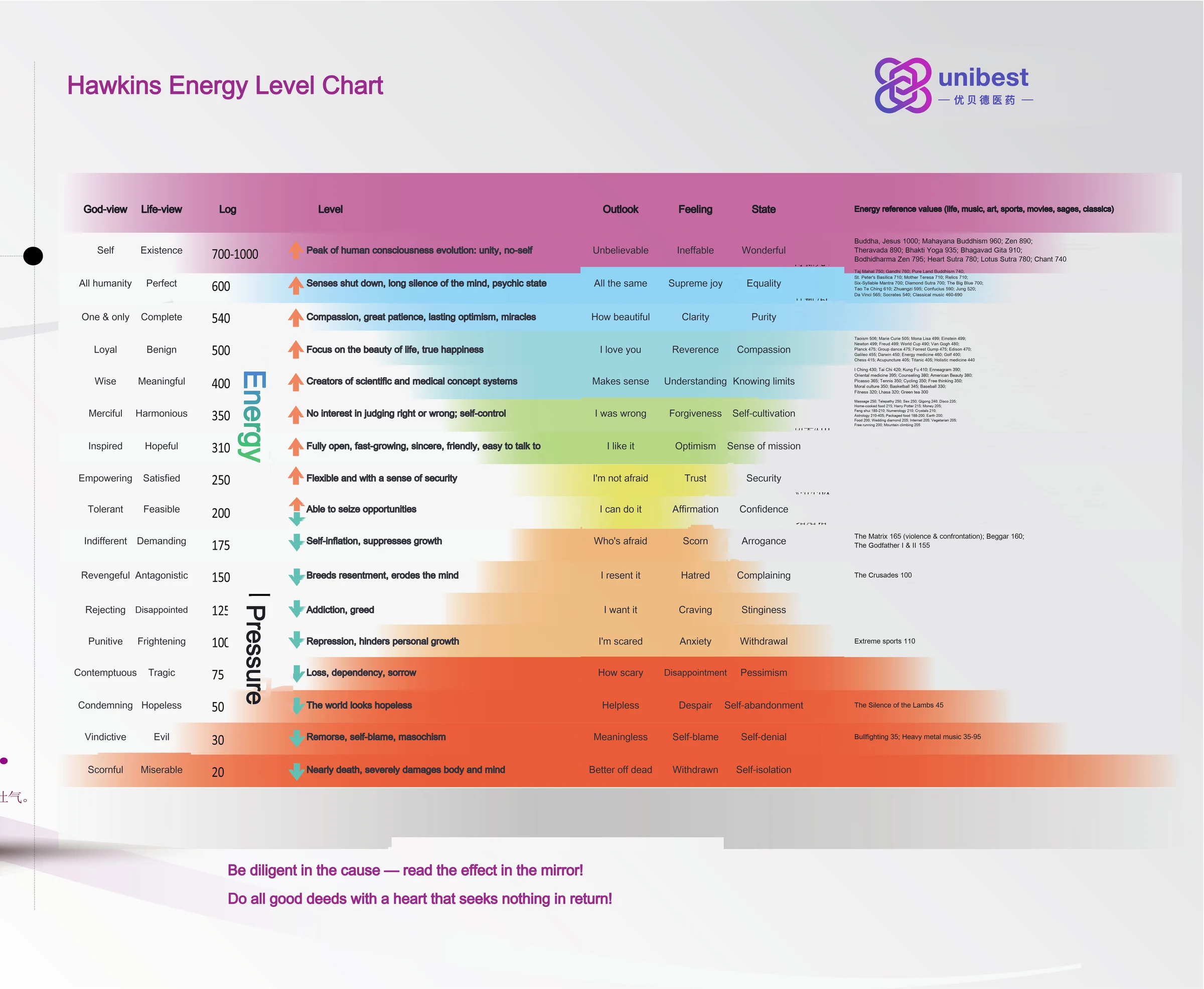
David Hawkins' Power vs. Force maps consciousness onto a scale: 20–30 shame, 50 apathy, 75 grief, 100 fear, 125 desire, 150 anger, 175 pride, 200 courage, 250 neutrality, 310 willingness, 350 acceptance, 400 reason, 500 love, 540 joy, 600 peace, 700 enlightenment. Two reminders: emotions have no moral polarity — grief, once faced, begins to transform; and the scale is for looking at yourself, never for measuring others.

Mapped onto organisations it becomes a sobering model: founders at 350–400, executives at 310+, middle managers at 250+ (unshaken under pressure), staff at 200+ (persistent). An outfit that strains past thirty people, or stalls at two hundred for years, usually has a strategy problem only in appearance — in substance, it has an energy-ceiling problem: organisations never outgrow the level of their key people.

Hawkins Energy Level Chart (course diagram)

Six Mirrors of Self-Knowledge

Knowing yourself is among life's core assignments — six models, each illuminating one layer: needs, thinking, growth position, deep values, blind spots and self-management.

Six mirrors: Maslow's hierarchy illuminates real needs; the six logical levels illuminate where you are thinking from; the growth-circle model locates you inside comfort, fear, learning, growth or freedom; the iceberg model exposes feelings, beliefs and yearnings beneath behaviour; the Dunning–Kruger effect marks what you don't know you don't know; and the personal business canvas treats you as a company — customers, value proposition, cost and revenue.

Any single mirror can flatter you: needs alone rationalise desire, strengths alone hide blind spots. Run all six and cross-check — self-knowledge is not a single epiphany but a repeatable examination programme.

Cause, Condition and Consequence of Emotion

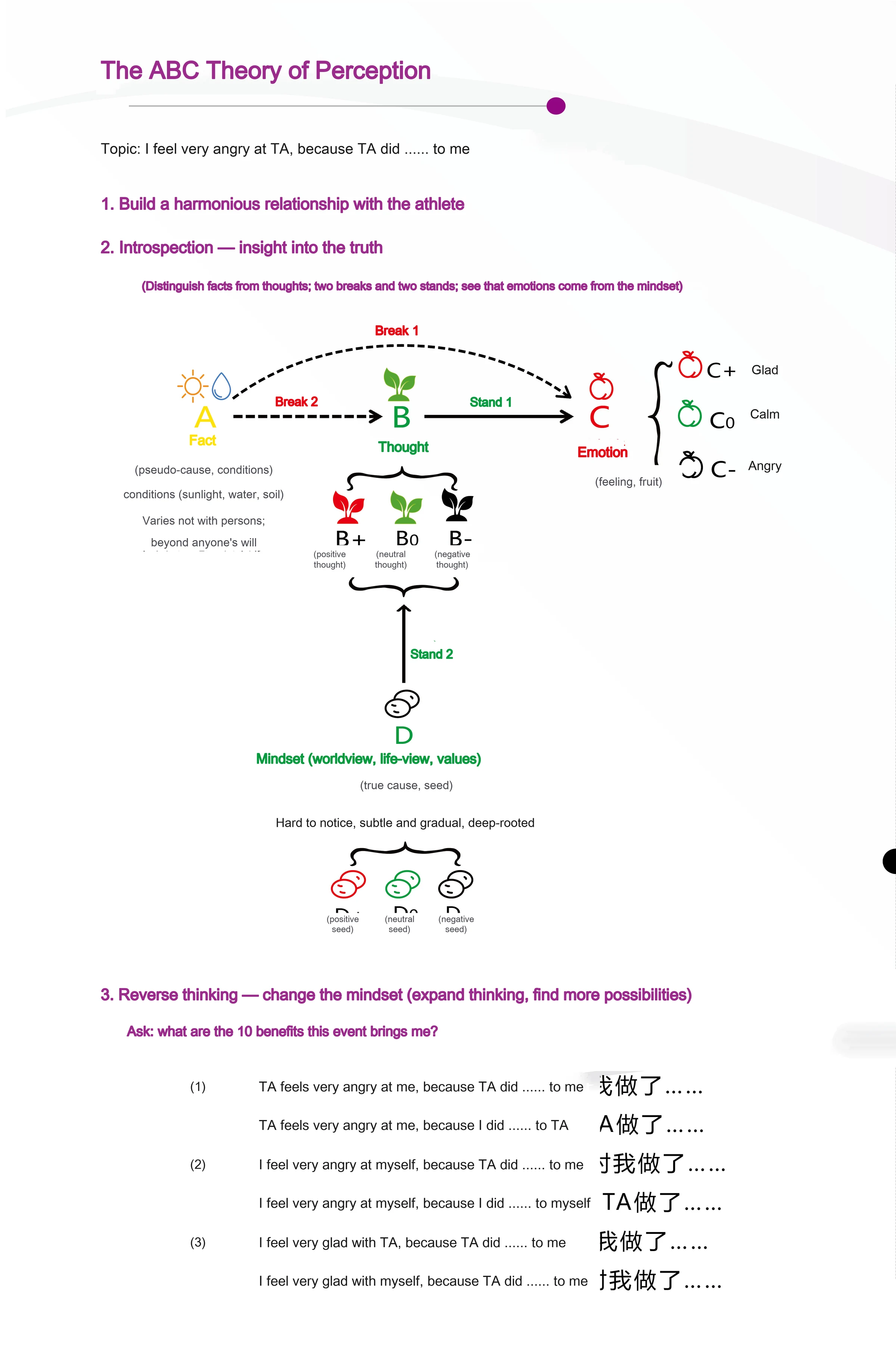
Emotion arises not from facts but from thoughts; thoughts arise not from others but from one's mental models — one finger points at them, four point back at you.

Emotion ABC: A is the event, B the belief, C the emotional consequence. Most people write the causality backwards — "he did that, so I am angry." Three moves expose it. First, separate fact from thought: rain is a fact, "what awful luck" is a thought; facts do not vary by person, thoughts do. Second, trace thoughts to mental models: given the same material, everyone reads it from a different angle, because the deep, unexamined assumptions differ. Third, distinguish cause, condition and consequence: the seed in one's mental model is the cause; the other person's act is merely the condition; the emotion is the fruit. Mistaking condition for cause is the cardinal error.

Once seen, two practices follow. Inquire inward: "I am angry at X because..." — is that causal claim actually true? Could the other person have been under crushing pressure? Reverse it: flip subject and object, swap the emotion word — not to console yourself, but to break the fixed neural pathway and widen the space of possibilities, until one truth stands clear: only by turning attention to one's own thoughts does command of one's fate return.

The ABC Theory of Perception (course diagram)

Three Strata of Belief: Where REBT and CBT Enter

The entry point for changing emotion is belief: dispute irrational beliefs directly (REBT), or descend from automatic thoughts to core beliefs (CBT).

Two therapies, one ancestry, different doors. REBT (Ellis) enters at belief: negative emotion follows irrational beliefs with three signatures — demandingness (must, should), overgeneralisation, and awfulising. CBT (Beck) enters at automatic thoughts: emotion, behaviour and cognition form a continuum, and cognition has three strata — automatic thoughts (fleeting), intermediate beliefs (attitudes, rules, assumptions) and core beliefs (ultimately: am I lovable? am I capable?). Automatic thoughts are generated by the strata beneath, so the fleeting is easiest to fix and the core hardest.

The practical tool is ABCDE: catch the reflexive interpretation (B) after the event (A), observe consequence (C), dispute it (D) — what other evidence, what other angle; accept the unchangeable, change the changeable — then energise new action (E). Useful substitutions: "must" becomes "prefer", "always/never" becomes "this time".

Fast and Slow Thinking: The Bill for Intuition

Most of the time we run on intuition — the first act of good decision-making is knowing when to slow down and summon the deliberate system.

Kahneman's Thinking, Fast and Slow: System 1 is fast, automatic and always on; System 2 is slow, effortful and only roused when System 1 stalls. The division of labour is usually efficient — but System 1's outputs (impressions, intuitions) do not always reflect reality, and the lazy System 2 often rubber-stamps them. Hence a stable catalogue of biases: mere-exposure (familiarity mistaken for truth), confirmation, halo, framing ("90% survival" equals "10% mortality"), anchoring, small-sample overconfidence, availability, loss aversion, endowment, peak-end.

Three workable counters: slow down at high-stakes moments and summon System 2 deliberately; bring in outside views — spotting others' errors is far easier than spotting one's own; and run the premortem — assume the plan failed a year from now and spend ten minutes writing the post-mortem. Intuition is not the enemy; unexamined intuition is.

Framework Thinking: No Overlap, No Gaps

The quality of reasoning is bounded by the quality of the frame — with MECE frames, thinking becomes both exhaustive and structured.

MECE is two rules: no overlap, no gaps. Real exhaustiveness comes from completeness thinking — if success needs A+B+C+D, missing one means no success. Example: sustained success = strategy × organisational capability; capability splits into willingness × ability × permission — mindset (culture, pay), ability (grow, hire, retain, exit, borrow) and governance (structure, systems, resources), each layer exhaustive.

One pocket frame covers most ground: the cognition circle — what it is, why it matters, how to do it, what to watch out for. Answer all four for any new topic and you are already ahead. A frame is not a cage; it is the skeleton on which scattered points become a system instead of a list.

The Arithmetic of Happiness: Possession over Desire

Happiness is possession divided by desire — managing desire beats growing possessions, and altruism with meaning is the undervalued lever.

One can write HI = Σ(Px/Dx × SMx) × Mx × 1/(1+Rx) × g(Px): possession over desire, weighted by social meaning, moderated by satisfaction and risk, clipped by a threshold function. Three evidence-backed insights: the Easterlin paradox — income growth matched by growing desire leaves happiness flat or falling; the threshold effect — beyond a point, marginal utility turns negative (work past the critical hours corrodes health and relationships); and social meaning is the undervalued lever — altruistic behaviour durably raises satisfaction. Ma Kah-wai's line nails the denominator: one yuan of desire below your income is financial freedom.

The formula itself is a frame-thinking exercise in iteration: from weighted factors, through ratio structure and risk adjustment, to a layered dynamic model. Its practical conclusion is plain: shrink the denominator (desire management), raise the meaning terms (invest time in skills and legacy), and respect the thresholds (do not overload).

Twelve Factors of Destiny: Reverence the Given, Manage the Earned

Revere the given without submitting to it; manage the earned with patience — destiny as a set of dynamically allocated parameters, not fate.

First life, then luck, then place; fourth good deeds, fifth study; sixth name, seventh bearing, eighth reverence; ninth mentors, tenth health; eleventh choice of work and spouse; twelfth seeking fortune and avoiding harm.

Source: Traditional fortune rhyme (modern reading)

Sort the twelve by controllability. The given (birth, luck): endowment and the window of the times — high weight, near-zero control; the right attitude is reverence and identification: know your starting point and cycle position, and do not bet heavily against the wind. The environmental (place, name, bearing, mentors, reverence): living and working surroundings, reputation, and the inner circle of five — all optimisable, all leveraged investments. The earned (deeds, study, health, choices): good deeds compound into trust capital, study compounds into cognition — the sustained learner's mental capacity overtakes the non-learner's with age; and choice (career, spouse, risk avoidance) carries the highest return per unit of effort.

The dynamics matter more than the static weights: early life is dominated by the given; mid-life by the earned (deeds, study, image compounding); later life by strategy (health and choices rising). The framework's value is not fortune-telling but resource allocation — a standing reminder to keep investing finite time and attention in the factors that appreciate.

Other disciplines

Back to overview →10 public viewpoints in this discipline

This material is a synthesis of public sources and operating experience, offered for methodological discussion. It is not a quotation, compliance opinion or legal advice on any specific transaction; on regulatory and sanctions matters, the target-country authority and our compliance lead decide.